Showing posts with label culture. Show all posts

Thursday, January 10, 2008

Makkah in the Media

Over two and a half million pilgrims made the hajj this year, but millions more were able to "live the haj", to adopt the LBC channel’s slogan for its special coverage of one of the world’s largest religious gatherings, by following it on the radio, TV and Internet.

The fact that LBC, a Lebanese entertainment channel, devoted a considerable share of its daily broadcast to covering the most significant event in the Muslim calendar shows to what extent Makkah becomes a media mecca, in the English sense of the word, during the hajj season.

One of the oldest and most successful programs began with radio and expanded into television: a live broadcast coordinated between Arab radio stations on the day of Arafa, the most important rite of the hajj. By the time the reporters from all twenty-two radio stations have had their say its sunset in Makkah, signalling the approach of Eid ul Adha next day. Tuning in has become part of the celebrations for many, and even the dedicated channels covering every aspect of the pilgrimage live have not displaced it.

There is the occasional reporter woefully inadequate to the task - it’s not difficult to introduce some quality control, the Libyans for example always do a great job, as they are always from the Quran Radio station. The format - short segments on the same topic strung together - mean repetition is inevitable, and the phrase “and now I pass the mike to my colleague from the…station” only has so many variations.

For Alarabiya, the Dubai based Saudi funded alternative to Aljazeera, finding new topics seems to have become an obsession, with a piece on camels decorated, or a report on the changing fortunes of Polaroid photographers who used to do a brisk trade before camera phones became the rule rather than the exception.

Aljazeera itself, the first pan-Arab 24 hour news channel, has been banned from covering the hajj for the last five years, but was allowed to return this year. It’s reporting focused on ‘giving a podium to those without one/voice’- and quite literally too, for example giving a group of pilgrims who could not afford to do their hajj officially, a chance to voice their complaints, instead of simply demonising them for taking an illegal route that exacerbates the Saudi governments logistical challenge, as has become routine on other channels.

Aljazeera Talk, the group site run by young bloggers and supported by the channel, also had special coverage under the slogan “Aljazeera talk goes on Hajj this year” with its citizen-journalists becoming pilgrim-journalists, writing about everything from hajj guides to fashions in headgear among pilgrims. Riz Khan, who began the fashion for western media coverage of the hajj almost a decade ago on CNN, was one of the first journalists to join Aljazeera English, which like the rest of the networks, was unable to send reporters to Makkah last year. However this, its second hajj, was covered by two reporters, Hashem Ahelbarra and Sami Zeidan, and in ihram no less.

Of course this year most western media have been preoccupied with the Iranian president, CNN anchors for example kept bombarding the reporter with questions as to Ahmadinajad’s whereabouts, so she had to preface everything she said with “we haven’t actually caught a glimpse of him”.

The attitude to hajj in much western reporting is encapsulated in the headline of a much reprinted AFP piece, “Hajj Intimidating for Secular Reporter”, and what actually gets covered is summed up with admirable brevity in this line from the Sky News online article “more than two million pilgrims have braved flies and scorching heat in the Hajj this week”.

The article actually dealt with an interesting subject though, the latest addition to the Islam Online island in Second Life, a virtual world which a ‘population’ of over 10 million. IOL has recreated Alharam AlMakki, Mina, and Arafa in 3D graphics, allowing Second Lifers’ to go on a virtual Hajj, which the IOL team sees as a “powerful educational tool for people embarking on the soul-searching journey in the real world”, as well as an experience open to non-Muslims curious about what the Hajj involves.

published in the Tripoli Post

Thursday, December 27, 2007

Shakespeare in Arabia


Although Arabs generally see the theatre as a recent import from Europe, different forms of performing arts, such as shadow plays, Sufi and Shia miracle plays, and the oral performances of poetry reciters and storytellers, have a long history in the region. Acting troupes also entertained aristocrats in their palaces, travelling merchants in khans, and competed with other street performers for the attention of shoppers and passers-by in the maidan.

While such traditions seem comparable to the earlier forms of European dramatic art from which the theatre evolved, a few play scripts have recently been discovered, suggesting an Arab theatrical tradition comparable to the Chinese or Indian for example.

However, as with music, Arabs made no real attempt to preserve a fixed record. In the case of music this was because improvisation was seen as essential, which might also be the case for drama. But, while both music and performance arts survive in the folkloric tradition, the native theatrical heritage does not have an equivalent to the ‘high’ status form of classical Arab music. Historical records provide the life story of the legendary Zeriab, who brought the music of Baghdad and Damascus to the Andalusian court; but no mention is made of playwrights, which indicates that dramatic performance were seen as mere amusement.

The Arab world only began to consider drama as ‘art’ after the introduction of works by European playwrights, of whom Shakespeare was the foremost, the ‘canon of canons’, as Khalid Amine puts it.

Amine goes on to argue that the “making of the Shakespeare myth” in the Arab world was not spontaneous, but “was induced through the implantation of a whole apparatus of translation and theatrical reproduction” following an unequal colonial encounter.

After independence, Amine says, “Shakespeare becomes a paradigmatic icon of the 'Western Other' or the Other's dramatic medium”, so that artistic engagement with his work by the postcolonial dramatist “amounts to a dialogue with the West and the Western dramatic tradition”.

The Nigerian
Wole Soyinka has another take on the relationship of the Arab cultural establishment to Shakespeare. In his essay “Shakespeare and the Living Dramatist” he surveys Arab appropriations which seek to “claim him as one of their own”, and disparages Arab “translations and adaptations” of his work. However he ends by concluding that this still leads back to the immortal source, “to the gratification of celebrating dramatic poetry anew”, which reverses the earlier power dynamic that presents the English genius as the object of inept manipulation, and seems a positive spin on the process Khalid Amine describes.

Margo Hendrix argues that Soyinka’s essay anticipates two related points later raised by postcolonial theorists: recognising that importing the Shakespearian canon requires the absorption of culturally alien elements; but also the fact that the plays contain so much foreign material (settings, characters, topics, or just the odd reference –like Lady Macbeth’s “All the perfumes of Arabia will not sweeten this little hand”). The plays themselves are in a sense internationalised in their own right, as texts and not just in terms of appreciation.

Shakespeare’s fascination with the unknown and unfamiliar was a feature of the theatre during the Western ‘age of exploration’ (or exploitation for those on the receiving end); but what sets him apart is his complex treatment of ‘the other’.

Shakespeare’s play Othello, in it's exploration of paradoxes and inconsistencies, is frequently cited to as the most striking example of this complex treatment . The title character being a North African commanding Christian European forces against an invasion by the expanding (European Muslim) Ottoman Empire, and the hatred, or at best ambivalence, with which he is regarded by the Italians whom he ‘defends’, have been linked to similar paradoxes and inconsistencies in Shakespeare’s Britain.

Although ‘Turk’ and ‘Moor’ were words that inspired fear and loathing, Queen Elizabeth I had alliances with both the Ottoman Sultan and North African states against her Catholic rivals. Mark Hutchings discusses the fearful fascination with the ‘Turkish Threat’ in English plays of the time, arguing that by drawing on memories of the fall of Constantinople and “perhaps an older 'crusader' narrative”, plays provided a safe thrill for an English audience who, as opposed to most of Europe, were not in reality threatened. The Turks were essentially the Godzillas and King Kongs of Elizabethan cinema. Nabil Matar’s book Turks, Moors and Englishmen in the Age of Discovery details extensive commercial relations and cultural exchange, including the fact that it was much more likely, and profitable, for an English adventurer to move to North Africa than North America.

Khalid Amine, in “
Moroccan Shakespeare: From Moors to Moroccans”, charts the development of a range of responses to Othello specifically and the Shakespearian canon more generally, from “celebrations of Moroccan presence in the English Consciousness”, to more radical rewritings of Shakespeare’s plays.

Such subversive strategies are present in the titles of Abdelkrim Berrchid’s two plays. Otheil Wa Alkhail Wa Al Barudu re-arabises the Othellos name, and to anyone familiar with Arab poetry echoes a line by Almutanabi, while Imri’u Alqais Fi Paris replaces Hamlet with the pre-Islamic poet who faces a similar “to be or not to be” predicament in a destructively futile revenge tragedy.

Set in the present, the play is a re-visioning of Hamlet’s “tragedy of delay and procrastination…[as] a collective tragedy rather than an individual tragedy” as Khalid Amine puts it, quoting Berrchid who says the “The new Imruù al-quays cannot be but the spirit of this new age, that is the age of homesickness, murders, and military coup d'état, and the migration of intellectuals and laborers in search for bread and dignity”

In this new age Shakespeare has not lost his potent spell, but there are conflicting ways of putting it to use. Some Arab playwrights strip Shakespeare of what Amine calls the “aura of authority” created by European dominance in order to rewrite his work in terms of their own concerns.

Sulayman Al-Bassam, the British-Kuwaiti writer and director of ‘the Hamlet Summit’ and ‘Richard III: An Arab Tragedy’, presents his project of adapting Shakespeare’s plays to the politics of the modern Arab world in exactly the opposite way.

He insists on the “aura of authority”, or what he calls “the global
accreditation”, with which Shakespeare is invested; seeing it in positive terms as giving the Arab dramatist “not merely a mask but a bullet-proof face” with which to face the censors.

More problematic is Al-Bassam’s assertion that “A fundamental pre-modernity is at the core of both the Shakespearian world and today’s Arab world”, which sounds like something straight out of The Collected Orientalist Stereotypes. His adaptations engage with the original context in a much more complicated and productive way.

But this point is made in even broader terms by reviews of his plays, which inanely and repetitively begin by saying that Arab world’s woes cry out for Shakespearian treatment, and back it up by noting one thousand and one parallels with England emerging from the Middle Ages.

Perhaps the best commentary on such reductive simplification of a postmodern and postcolonial situation to stereotypes of towel-heads in the dark ages is the fact that ‘Richard III: An Arab Tragedy’, part of the RSC’s Complete Works Festival, was on at the same time as another Richard III adaptation - set in modern Britain.

The director of this Richard III, Michael Boyd,
sees both his and Al-Bassam’s plays as dealing with "the tendency, very difficult to resist, of pulling more power where power was in the first place, of increasing the centralization of power”, and draws his own parallels, the totalitarian behaviour of democratic governments in the context of the war on terror, citing the manipulation of information to create and use “fear as a political weapon, fear as a means of censorship, a means of mobilization, a means of justifying arrest”.
This is the same ‘war on terror’ which in ‘Richard III: An Arab Tragedy’ is used as a pretext for tyranny and occupation, setting up an equivalence between the invading American general and the Arab Dictator. The French adviser to the Emir boasts that he “can make a mockery of the judiciary; thread an axis of evil through the eye of the press; I can turn a democracy into a tyranny and keep it all as clean and transparent as a Security Council resolution".

What the two Arab re-makers of Shakespeare, the Morrocan Berrchid and the Kuwaiti Al-Bassam, have in common is their mixing of Arab and Western forms of performance in their theatrical art.

In Berrchid’s case, as in that of many Arab dramatists, this includes a conscious decision to incorporate native dramatic traditions, such as the Albsat tradition of improvised comedy with a political message. Al-Bassam’s Arabian-Shakespearian tragedy contains recitals from the Holy Quran and folkloric dance and music, as well as email messages, phone conversations, Aljazeera newscasts and a religious TV show.

They both create a mixed form which mirrors their content, a hybridized product of Arabia and Europe, East and West.

Saturday, December 15, 2007

Nabil Moussa: Artist? Craftsman?


hibo has discovered Ali Baba's cave...on the bbc site: a photo journal on a Libyan brass engraver, who bases his designs on Christie's antique price guide and hopes to expand through the internet.

Reminds me of the Art or Craft argument over Dale Chihuly's glass sculptures.

Thursday, December 13, 2007

All That Glitters

A Libyan lama: women occupying the guest’s sitting room in a friend's house, dressed up in their best and decked out in jewelry, the talkfest only interrupted by relays of trays. It couldn’t be more different from a busy stock exchange floor.

But at a lama, every topic is discussed with gusto and plenty of gesticulation, and one thing that’s sure to come up is the price of gold, down to the last decimal point; with predictions of future fluctuations taking into account everything, from the birth pangs of the new Middle East to rising demand in China, the weakening dollar and warnings of a global recession. It’s like listening to a room full of Farah Albaraqawis, only all the economic news is seen through gold-tinted glasses.

A girl is initiated into this dazzling world before she’s a month old. The most common gift for a newborn girl is jewelry, especially pendents. These are quite distinctive, there are engravings of Quranic verses, quirky ones like teapots, and charms based on pre-Islamic ‘magical’ symbols like the fish, hand, eye and the horn (which also survived in henna patterns and weaving - like carpets and silks); believed to ward off the evil eye. Within weeks, or sometimes days, of birth a girl will also have her ears pierced, and there are even miniature bracelets, so all that’s missing is a ring.

When all the relatives and friends have given their congratulations, she’ll have quite a collection with which to start a gold hoard, which steadily accumulates through presents for Eid, birthdays and good exam results. Of course some pieces will get broken, and not everyone wants to keep baby pendants for sentimental value, so there are plenty of opportunities to learn the basic rules to managing your gold fund: obviously to buy when the price falls, if you have things you want to get rid of hold onto them if possible till its back up again, or at least only sell when you’ve decided on exactly what you want instead.

More important are the endlessly drummed perquisites to a good buy - as few jewels as possible (as they’re weighed as gold when you buy but removed if you sell), to only buy 18 carat or above, and to avoid designer pieces like the plague, as they date quickly and a big percentage of the price is not in the recoverable net weight.

So all in all, shopping for jewellery is defiantly not for magpies attracted to shiny things, it calls for a disciplined investor’s eye.The goal is a stash that can be worn, loaned to friends and relatives, and updated with minimal extra outlay, and which can also be turned to cash when needed. If any pieces are not used regularly 2.5 % the value is given in Zakah each year, as they are regarded as savings in Islamic law, and a percentage is owed to charity.


Wearable wealth goes back a long time, and the older designs, with coins or even gold nuggets on a chain, make their function very clear. The craftsmen who make the jewelry worn with the traditional costume still use coins for decorative purposes, but they have to ‘mint’ their own since the Ottoman lira is a collectors’s piece now - forgery in 24 carat gold.


A complete set of Libyan jewelry includes the necklace, the most important piece, which can be anything from one row to five, and comes in many designs (with names like ‘the company’ and ‘the crescents’), matching earrings, and a multitude of rings and bangles – not to mention ‘extras’ like anklets, tiaras, and gold belts.

The jewellery has become more elaborate and expensive over the past few decades, so affordable versions are produced which are beaten very thin, making them fragile, and much less attractive than the cheaper and more durable gold plated silver sets which are now becoming more acceptable, even for a dowry. A ‘fake’ set means the bride can still wear the traditional suit, but receives more modern jewellery. Although such sets can’t be exchanged as real gold can, they’re not worn more than a few times a year; and there are even jewelry rental shops opening up to cater to those who still want to keep up with the latest designs.

All of this seems to be the death knell of traditional jewelry making, buying and wearing. But actually heavy silver jewellery and lighter gold pieces were what earlier generations wore, so perhaps modern conditions are turning women back to more reasonable, if less picturesque, jewellery.

Tuesday, December 11, 2007

Omaima Khalil

She has an amazing voice...


Sunday, November 18, 2007

Shahrazad Goes Live

I don't always agree with Fatima Mernissi, but she does have the most fantastically bizarre and yet wondefully commensensical ideas.

In 'The Satellite, The Prince and Sheherazade', she explores "the empowerment dynamics of satellite broadcasting" and "Arab audiences' fascination with strong female hosts and war reporters". These women, who have become household names across the Arab world, fit the "Sheherazade profile, the brainy, self-confident storyteller":


Promoting strong female stars has proven to be a fantastic asset for the Saudis' most threatening TV rival. Al Jazeera is winning crowds every night through the eloquence of its news anchors, Jumana Nammour and Kaduja Bin Guna, and economics expert Farah al-Baraqaui. While state televisions and oil-funded channels traditionally limited their staff by censoring them and denying them the right to decide freely about their program content and what guests to invite, Al Jazeera'ssuccess is due precisely to the freedom its programmers and speakers enjoy, which allows them to become credible communicators. "


Channels that want to be viable are required to rely much more heavily on high-impact 'brands' and product lines. Al Jazeera demonstrated the worth of such assets when it developed a range of programs whose titles and presenters have become household names inside and outside the Arab world," explains Naomi Sakhr, the author of Satellite Realms: Transnational Television, Globalization and the Middle East.


The most famous reporters in the Middle East today are probably the Palestine-based Al Jazeera reporters, Shirin Abu 'Aqla and Jivara al-Badri, who are admired for their courage and professionalism. "History will remember that day when there was no one to speak up in the entire Arab nation, from the Atlantic to the Persian Gulf, but women such as Shirin Abu 'Aqla and Jivara al Badri and Leila Aouda," comments Ali Aziz, the columnist of the avant-garde Egyptian magazine 'Critiques' (An-Nuqqad), "while male leaders and gallon-wearing generals have disappeared from our sight and hearing."

Fairuz's ya sharazade


Katia Nasser discussing her experience as a war correspondent during the 33 day war:


Friday, October 19, 2007

The Poet And The Journalist

I missed the beginning of Tamim Barghouti's poetry reading - performance actually- in Ramallah on Aljazeera Live, but I could see that almost half the people in the audience were pointing their phones/cameras at him, so I wasn't too worried.

Sure enough someone had uploaded the entire 'concert' on youtube - and I found out that he had been introduced by Jivara AlBudeiri! I thought I recognised her voice, but I wasn't entirely sure until I read this account of the evening from the Al'ayam newspaper.

Perfect right? The next Mahmoud Darwish introduced by the most passionate and committed journalist on Aljazeera. If only words really were more powerful than bullets.


Friday, October 5, 2007

Freej

I just read (at an unlikely place) this old news: Emarati animation Freej’s winning the country award at the Hamburg Animation Awards.

It’s not like there were any competitors of similar caliber in the region so I doubt it came as a huge surprise.

The viewing figures for this ramadan are a real achievement though, and it’s also credited with “creating a dialogue”, within a society which as one of the design team says “no longer gathers together, not even during Ramadan” except to watch Freej.

It’s a less extravagant claim than Ajaaj the sandman’s proposed role as national identity and native pride booster.

Wednesday, August 8, 2007

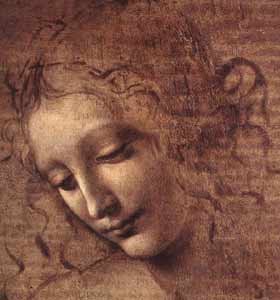
Leonardo's mother: an Arab slave?


The Arabist has this from Discovery:

Da Vinci Fingerprint Reveals Arab Heritage?

Rossella Lorenzi, Discovery News

Oct. 28, 2006 — Leonardo da Vinci may have had an Arab heritage, according to Italian researchers who have isolated and reconstructed the Renaissance master's fingerprint.

The fingerprint represents the only biological trace of the Florentine genius, said Luigi Capasso, an anthropologist at Chieti University...Fingerprints are unique and don't change over a lifetime. Analysis of the skin's arches, loops and whorls — a science known as dermatoglyphics — has shown that there is a link between fingerprints and populations.

In the case of Leonardo's fingertip, patterns and ridges pointed to the Middle East, the researchers concluded. "The fingerprint features patterns such as the central whorl that are dominant in the Middle East. About 60 percent of the Middle Eastern population display the same dermatoglyphic structure found in the fingerprint," Capasso said.

The discovery would support Vezzosi's claim that Leonardo's mother was not a local peasant girl as previously thought, but a Middle Eastern slave. According to Vezzosi, records unearthed in Vinci offer substantial evidence that Leonardo's father, a craftsman called Ser Piero Da Vinci, owned a Middle-Eastern female slave named Caterina.

"It was common in 15th century Tuscany to own slaves from the Middle East," said Vezzosi. Indeed, in 1452, the same year of Leonardo's birth, a law was passed in Florence that gave slave owners greater rights over their slaves. Shortly after the law was passed, Ser Piero married Caterina off to one of his workers. The woman had just given birth to a boy called Leonardo.

Wednesday, August 1, 2007

Sandcomics - Arab cartoons and national identity

This advert has been running on all UAE channels for a while, and what with the repetition and the cool graphics, I felt compelled to go check out the website it advertised.

Turns out there is a new bilingual Emarati comic that will be distributed both in printed form, at an as yet unspecified price, and an online edition will provide a downloadable page every day.
The idea, in the words of Ahmad Almansuri, is that it should "promote national identity and show the traditions of this Gulf state to visitors "

I find the whole concept of 'native pride' a bit iffy, and as for Sandman as the incarnation of the spirit of the past ...as Asia said "DAMMIT! muslims PLEASE be original ".


Some of the artwork is very good, but not up to the standards of the TV trailer. And the super hero Ajaaj doesn't seem to have been fully developed - what can you say to this for example:


Then there's the name.

3asifa Ramliya (Sandstorm) not being a very catchy, they came up with Ajaaj. Which has a sort of nice ring to it…only instead of conjuring up some primeval force bearing the ‘values of the desert’ into a futuristic city, it is - to me at least- synonymous with those ‘ayam 3ajaj‘ when you’re cooped up at home, with nothing to do but think about whether to dust or not to dust.

So overall it was a bit disappointing. I was expecting something like the Khaleeji cartoons last Ramadan, the Saudi and Emarati ones were pretty awesome.

Almost every national Arab channel has a short let's-make-fun-of-ourselves cartoon during the fasting month, usually aired around if6ar time, for a local audience.


Highlander has blogged about our own 7aj 7mad, the great dissector of Libyan mores, who desperatly needs a make-over as her photo makes clear.


Last year the Saudi's aired يوميات مناحي on their pan-Arab mbc - it dealt with topics from youth unemployment to Iraq. Sort of like 6ash ma 6ash but more understandable :P, so it was the content rather than the technical presentation that mattered.

It was the Emarati الفريج however, broadcast on Dubai, that broke the usual format of a well-meaning male fool as the central figure and representative of the 'national character'.

Instead there were four older Emarati women of varying ethnic and social backgrounds, personalities, and I.Q levels. It was visually visionary too, being the first Arab 3-D animation.


Sunday, July 29, 2007

Resurecting the past, or retrieving forgotten knowledge?


Reorganising my dad’s books I came across this arresting title, Alfiya mukarrara fi al-amrath al-nafsiya almu3tabara( ‘the thousand’ Alfiya repeated on important psychological disorders) a book-length poem which combines the many talents of Dr. Salim 3amar:
the first professor of Psychiatry in the newly independent Tunisia’s national university, he has published over 300 research papers and won a prize for his book on schizophrenia; but his interests are not limited to the strictly scientific - he is a prominent member of the International Society for the History of Medicine, has written extensively on Arab and Islamic Medicine, and has a passion for poetry.

As the introduction, by a former Tunisian culture minister states, ” is there anything stranger than the case of this ‘Alfiya’ which appears even in it’s name to be a rare example of an attachment to heritage and a desire to revitalise it with the spirit that created it in the past”?
Indeed a modern Arab book with a rhyming title in the medieval fashion is a novelty in itself, but this one is also more specifically placing itself in relation to Ibn Sina’s Alarjuza Fi Al-6ib ( alarjuza - from rajz, one of the seas of poetry- on medicine; often called the Alfiya because it has 1000 odd lines). In fact Dr. Salim 3amar proclaims his poem an Alfiya Mukarrara, as it has 3500 lines.

Writing a poem, even if not great in the aesthetic sense and regardless of the topic, of such length is an achievement; and as this one conveys detailed information on psychiatry for a lay audience in an uncomplicated way it is is a doubly impressive one…but I wonder if it is worth the effort?

However there seems to be no reason why a book on psychiatry printed in 1992 should be a poem, and the limitation of the rhythm must have adversely affected Dr. Salim Amar’s treatment of his material, and is offset by no positive practical benefit.

The book seems to ‘degenerate’ into a mere curio, even in the fulsome praise of the minister of culture who ends by declaring “this Alfiya is thus given a unique character, and becomes a wondrous treasure [tuhfa 3ajiba]…so the reader should enjoy it’s manner as well as it’s matter, as every person of taste enjoys everything that is rare and precious”.

Printed on glossy paper with patterned borders, the two column layout of traditional arabic poetry reinforces the ‘gimmicky’ effect of the rhymed chapter and subtitles, the cover illustration from a medival manuscript, and the title which echoes the descriptive rhyme of the inumerable Alfiyat across the centuries on everything from grammar to theology.

In short, Dr. Salim 3amar’s Alfiya mukarrara fi al-amrath al-nafsiya almu3tabara ends up being just the sort of book people only buy as gifts, ending up looking good and gathering dust on a shelf.

A different approach is taken Dr. Sami Mahmoud, who supervised a recent edition of Tadhkirat Uli Al-albab wa Al-jame3 li Al-3ajab Al-3ujab (The memorandum for the intelligent, and the compendium of the wondrously strange) by Dawud ibn 3amr Alan6aki, and says he found his original intention to publish a full or even abridged version impractical.

Instead of seeking to slavishly duplicate what was produced to fulfil the needs of a different era, Dr. Mahmoud used the Tadhkira as a basis for a book he calls Tadhkirat Dawud Lil-3ilaj Bil A3shab wa Al-wasa2il Al-6abe3ia (Dawud’s memorandum on on herbal and natural treatments), the title says it all really- no rhyme, and he uses the phraseology natural to him as the writer of an earlier best-selling book on herbal medicine. Unlike Dr. Salim 3amar he sees no need to twist his expertise into an unatural form to revive the past, instead he goes back to it to take what is useful in a contemporary context.

The original Tadhkira is a massive three volume book - the first volume gives the properties of over 3000 medicinal plants and herbs arranged in alphabetical order, the other two deal with the diagnosis and treatment of alphabetically arranged illnesses and diseases; but it also contains detailed sections on topics such as veterinary science, farming and geography. The language is difficult, and at times obscure, and as the publisher says in his introduction, some of the elements required for the compounds are almost impossible to obtain, and others are unkown even to an expert.

This edition edits content and language, and after each entry on a plant or illness from the Tadhkirah adds the explanation in terms of modern science. As an active researcher in the field of herbal medicine, Dr Mahmoud provides additional uses for plants and treatments for diseases from other medieval texts, and from folk remedies.

Such an approach is actually much more in line with that of doctors and 3ulama like Ibn Sina and Dawud ibn 3amr, the latter says in a quote which serves as an epigraph to Dr. Sami Mahmoud’s book:
"We have chosen medicines that are easily available and inexpensive, to comply with the needs of the seeker, who if he agrees accepts, and if so his acceptance is an honour, and if not let him cover what faults he sees with the tail of forgiveness, for it is the ever-blessed (God) who is free from all deficiency and mistakes…and let my prize for this [work] be a prayer from him; God is the one who guides us to the right, and to him is the return and in his hands my fate, there is no power but God the high and great, he is the one I depend on, the most perfect sustainer"

Monday, July 23, 2007

Folktales without borders

Re-reading Marina Warner's From the Beast to the Blond her analysis of a German folktale, the Juniper Tree, reminded me of a half-remembered Palestinian one I'd heard as a child, The Green Bird, and when I checked it in Muhawi and Kanaana's collection it turns out to be a more than striking similarity.

There are quite a few differences in details of course, the one I found intriguing was the father's reluctance to remarry in the Palestinian version, fearing how a step-mother would treat his children, which made him more of a 'sympathetic character' than the father in the Juniper Tree - who nevertheless escapes death, despite similarly unconsious canibalism.

The avoidance of patricide and purging of all evils through the surrogate mother figure might be part of the Grimm brothers' reworking of their materials for the sensibilities of contemporary child

I don't mind bowdlerisation though; some experts seem to imply 'authentic' tales, crude and earthy and true, told by peasant hags in some hut and being disfigured by the Perraults seeking to satisfy a literate elite, but tales passed on orally are also changed at each telling with regard to the audience.

The Green Bird as I remember it told years ago, started of with the stepmother making kib'e and greedily gobbling it all up herself, and as we were old enough to enjoy being scared, we were told in gory detail how she made her step-son into a replacement meal, but there was greater stress on the father's constant worry about his missing son, who he is told ran away. The woman who told it might have heard it in this version, or she might have made her own changes...or maybe she first encountered it reading Muhawi and Kanaana's 's popular anthology.

The relationship between written and oral folktales should not privilege either, and actually with the tradition of elites gathering these narratives and recreating them in forms to suit their literary taste and social, or even political, purpose going back so many centuries, it seems senseless to imagine a folklore purely oral, even if oral narrative was to be seen as the more pure, essential form of these stories. They have always been a collaborative, collective effort, always something made, not just existing, constantly being consciously remade, not spontaneously mutating.

And not necessarily a cosy process around the home fires . The resemblance between Mameluk sagas like Sayf bin dhi Yazin, or Alf layla wa layla, and Russian folklore is usually explained with reference to the the Central Asian hordes marauding across, and then settling in, both areas. Battles and blood baths, are probably also the reason for this instance of cross-culturation between the fertile crescent and central Europe. In fact Warner's book makes a couple of references, in the context of legends based on Biblical figures, to Crusaders bringing back the Muslim folktales about Solomon and Bilqais the Queen of Saba2/Sheba for example, and adding them to the local mix.

So anyway, war and empire building/dashing seems to be an ideal time to swap fairy tales...will something positive come out of the creative chaos the region is currently experiencing after all?

The Green Bird
The Juniper-Tree

Monday, July 2, 2007

Badla 3arbiya

Literally Badla 3arbiya means 'Arab Suit', which seems a curious term, but like the similar 'raqs sharqi' or eastern dancing it's strange self-referentiality (as opposed to the descriptively inaccurate belly-dancing) is probably most significant in recording the fact that the 'native' was no longer the default.


In the Libyan dialect it refers to the traditional woman's costume: a tunic (gmaja), a sort of vest called a kurdiya, trousers and a huge length of cloth elaborately arranged over the whole. It is the latter that is the most distinctive piece, and the material, colour and wrap of it defines the ensemble, identifying the region and occasion.


A 6rabilsi (Tripoli) style gmaja and kurdiya with the matching r'da in the background. Nowadays women don't necessarily wear their region's design, and there are crazes for this or that style every wedding season.


Variations of this costume are worn in the Maghreb (North-Africa with the exception of most of Egypt), but even within Libya there is a wide range of styles. The major difference here is between the Eastern and the Western style: the gmaja is different, but it is mostly to do with the wrap of the r'da which in the East is usually worn higher up, a few centimeters below the knees, while in the west it almost reaches the ankles. To match this the Sirwal (what the occident likes to call harem-pants) is calf-length in the east and ankle length in the west, as in both cases it has to show from beneath the r'da.


A Libyan bride is given two such costumes by the groom, and as they are woven of silk and silver threads (although the latter are sometimes tinted gold), together with the jewellery she has quite a wearable fortune as this painting (from Flying Birds) of a Libyan 3arusa in full regalia shows.


The buttons are gold too! Like the jewellery one set of these is used with any number of 'badlat'- they're sewn unto the one you happen to be wearing.

A crescent moon, a five-pointed star and a hand - all are seen as 'Islamic' symbols although the hand in particular, which superstition regards as warding off the evil eye, is not.

There is usually a repeating pattern, which together with the colour combination creates the variable elements to each design. There are fashions and designers, and customers can also order their own unique creations direct from the specialised factories.

The same factories also buy the badlat, and burn them (!) to extract the silver from which to make new thread and weave new rdawat. Some are just about falling to bits and desperately need a reincarnation; but quite often the badla is sold because the owner wants to 'cash it in', whether because she needs the money, never wore it since her wedding or has worn it so often that she's sick of it and wants something more up-to-date. A less combustive form of recycling seems possible as I've heard people are now buying what is in good condition to use as fabrics for interior decoration.

Sunday, June 24, 2007

Sabe’a Sabaya - Libyan Folktale Retold


There were (oh the things there were!) in a time long past…two brothers who married two sisters.

The elder brother Zaid’s wife Nafisa was a wise and clever woman, who looked like most women do. His younger brother Zeyad married Jamila, who was what her name meant (a beauty). She was tall and slender as a palm tree; she had skin as delicate as jasmine, hair as dark and glossy as roub (date syrup) and the eyes of a gazelle. Her husband was as handsome as she was beautiful, and they were suited in character too, for one was as stupid and greedy as the other.

When the brothers’ father died and his debts were paid only two small farms were left. The brothers and their wives worked hard, but though they were never very poor they were never very rich.

One day Zaid decided to go to the ghawals’ palace and bring home some of their food and treasure. He told his wife of his plan, knowing that she would know how to help him.

“Elsabah rabah” (profit is in the morning) she said, "I’ll tell you what to do tomorrow.

"Next morning Nafisa was awake long before dawn. First she took a gas’a to the storeroom and filled it with wheat.

Then she picked the juiciest cucumbers from the farm and the biggest eggs from the henhouse. In the kitchen she ground some of the wheat into flour, and then she started making sfinz. Sfinz, as we all know, is better than wedding drums at waking up lazy lie abeds. And true enough when the aroma of his favourite breakfast reached him Zaid jumped out of bed and - without even washing his face - he rushed to the kitchen.

“Good morning” he said cheerfully.

“A morning of carnation and jasmine” Nafisa replied, “you had better hurry if you don’t want to miss dawn prayer at the mosque”

But, remembering that this wasn’t a day like any other, Zaid looked at his smiling wife in consternation; how could she sing at her tahouna and make sfinz when he was going on a quest as dangerous as any feat ‘Antar ibn Shadad had performed?”

“You’ve forgotten what I told you yesterday…” he protested indignantly, but before he could really begin to grumble he was interrupted by the first Adhan and had to hurry away.

Nafisa finished frying the sfinz and wrapped them in a cloth to keep warm while she prayed. Then she made date paste balls stuffed with almonds, cooked them in olive oil and put them into a leather pouch. Half the sfinz she sprinkled with salt and wrapped into a parcel, and this she packed into a gufa with hard-boiled eggs and cucumbers.

She was filling a second gufa with wheat kernels when a slightly shamefaced Zaid came back, but Nafisa was too prudent a woman to warm up cooling arguments, and they sat down to breakfast.

While they were eating sfinz with honey and sipping sage tea Nafisa gave her husband the advice he had asked for, and this is what she said:

“I’ll give you a gufa of wheat to mark your trail, because the ghawals’ magic will mislead you, and a pouch of date balls to eat on the journey, so you’re not hungry when you reach the palace. There’s a giant fig tree in their garden, you must climb up as soon as you arrive, and stay there all day and all night. The ghawal will shake it on their way in and out but if you do as I say God will keep you safe. At dawn the ghawal will set out on their hunt: eat the food in the gufa I will give you and then climb down and enter the palace from the back door. You will pass through six rooms, but you must not touch anything in them. Each room will have a table laid as if for a Sultan’s banquet, but you must not taste the food. Each room will be full of jewels and fine clothes, but you must not try them on. Each room will contain a mirror, but you must not see your reflection in it. From the seventh room you may take what you want, but remember the ghawal will come back at sunset.”

He promised to follow her instructions, and she gave him a water skin and the two gfaf, making a hole in the one full of wheat. So before the sun had had time to warm the world, Zaid set off towards the ghawals’ palace. Although he could see it far off their spells confused him and he found he was walking in circles, but he never took the same path twice because the wheat marked where he had been.

He reached the palace some time after noon and climbed into the fig tree, taking with him his two gfaf and his waterskin. He stayed in the tree all day, munching the rest of his dates. At sunset the ghawal came home, singing:

Sabe’a sabaya fi gesbaya

Sa’ad elghulah takelhen

(Seven girls, in a bowl

Happy the ghulah that eats them)

Before they went into their palace, each ghulah took hold of the tree and shook it, but Zaid was ready for them: he held on and did not fall.

Next morning, the ghawal got up early, and came out of the palace at first light. Again, each ghulah shook the tree, but Zaid held on and did not fall.

When they had gone, Zaid ate some sfinz with the eggs and cucumber his wife had packed in the gufa; then he climbed down, walked around to the back and entered the palace.

He walked quickly through the first six rooms despite the tantalizing smells and glittering sights, and when he reached the seventh he put down his two empty gfaf, and with his knife made an opening in the waterskin.

First he filled the water skin with rubies and emeralds and sapphires; with amethysts and turquoise and coral and strings of pearls…. and when it was full he tied it securely and strapped it on.

Next he put gold into a gufa: dinars and bracelets and rings; armbands and necklaces and anklets and earrings …and when it was as heavy as he could manage he covered it with the most magnificent r’da he could find: a cream and pale blue silk, shot with threads of white gold, it had taken two hundred women two hundred nights and two hundred days to weave in Samarkand.

And then he filled the last one with food. There were saffron strands and ginger roots and nutmegs; crystallized Aleppo pistachio and coconut and pine nuts; guava and mangoes and honeydew melons…When this last gufa was packed it was a little before noon.

Zaid put on a suriya of the finest linen and a jard woven from the hair of white camels, and then he picked up his gfaf and waterskin and set off home, following the wheat trail.

Nafisa had been waiting as if on hot coals for her husbands return and welcomed him home with zaghareed. That night they dined better than the Sultan in Turkey, whose cook was in a bad mood.

A few days later Jamila visited her sister. She noticed her wearing six heavy gold bangles and went home with her head full of nothing else. When her husband heard he too wondered how his brother could afford to buy jewelry, especially when he had told him that he was planning to buy more stock for his farm. So Zeyad went to his brother and asked him where this sudden wealth came from.

Now Zaid loved his brother but he knew his faults well, so he did not want him to go to the ghawals’ palace. At first he only told him that he had been lucky, and would share his good fortune with his brother. Zeyad however insisted that he should be told were the money came from, and this was how their argument went:

Zaid said: "I'll give you a quarter."

But Zeyad refused

Zaid said: "I'll give you half."

But Zeyad refused

Zaid said: "I'll give you all"

But Zeyad still refused

“You must tell me where you got all this” he said "so I can get more than you."

So Zaid told him exactly what he had done, and before they parted repeated his instructions to make sure he remembered:

"make a trail, take food with you, stay in the fig tree for a night and a day, hold tight to the tree when the ghawal come, enter the palace from the back, don’t touch anything in the first six rooms, don't look into the ghawals’ mirror, and don't eat their food when you are in the palace."

Zeyd took a bucket, bored holes in it and filled it with chalk. He did not take any food with him, thinking that his brother was just maliciously complicating his task.

"There is food where I am going," he thought, "why take any with me?" So early next morning he set off, but of course the chalk was difficult to see and he had a hard time reaching the palace as he kept going round in circles. When he finally reached it he went in straight away because it was getting dark and he was hungry.

Ravenous, he saw a feast fit for an Emir ready spread in the first room he entered, so he sat down to eat. The first sip of pomegranate sherbet, the first bite of roast lamb was in his mouth, and he was made mute. Then the fool dressed in rich clothes - the first glance in the mirror to see what he looked like in his new outfit, and he was struck blind. The first word of the ghawals’ song in the distance heard while he was still in the palace, and he was deaf.

Terrified he hurried out, found the fig tree and clambered up just as the ghawal came home, singing:

Sabe’a sabaya fi gesbaya

Sa’ad elghulah takelhen

(Seven girls, in a bowl

Happy the ghulah that eats them)

As they passed under the tree, they shook it. Blind, scared, and weighed down with the food he had eaten, Zeyad fell quickly. So the ghawal ate him, except for his head, which they kept.

Next day, worried, his older brother decided to go after him. Nafisa thought for a while, and then sat down and sewed her husband a brightly coloured costume with bells everywhere. When he wore it he looked like the ghoulish jester Bu Sa’adiya, and when he moved he made enough noise to wake the dead. Again, she gave him food for the journey and a gufa of wheat kernels. Early next day, he set off, singing:

Kulma gutlak ya'ebn umi khud rub’aa gutli la

Kulma gutlak ya'ebn umi khud nusa gutli la

Kulma gutlak ya'ebn umi khud kulla gutli la

(Whenever I told you o son of my mother, take quarter- you said no

Whenever I told you o son of my mother, take half - you said no

Whenever I told you o son of my mother, take all - you said no)

So he sang, until he reached the palace. The ghawal heard his song and his bells, and as ghawal like Bu Sa’adiya, they welcomed him joyfully. He came closer and saw that they were playing with his brother's head, throwing it from one to the other.

He approached a ghulah and asked her “honoured sister, whose head are you playing with, and how did you get it?”

She replied, “When we came back from our hunt yesterday the first mirror told us of a fool who broke into our palace, drank and ate at our table, and wore our clothes.”

“Indeed to act so he must have been as you call him (a fool).”

“So he was, it took us less time to gobble him up than it would take you to think up a new song.”

Then all the ghawal invited him to sing and dance for them. In return he asked that they allow him to join their game and, when he had finished his songs, to take the head away with him. They agreed, saying they had no more use for a fool’s head. So Zaid sang for the ghawa,l and they were so pleased with his songs that they sent him off with many precious gifts. When he returned to the village he went to Jamila and gave her his brother's head, and the gifts that came with it.

And that was the end of greed!

published in the Tripoli Post

Saturday, June 2, 2007

Bilingual Terrors


This post is really just an excuse to put up this cartoon by 3bd el-3al in Al-Arabi magazine, which for some reason I really really really like. As they don't say (or do they?) : simplicity is the mother of perfection.

Anyway so it's illustrating an article by Dr. Hamid Tahir, a Professor of Islamic Philosophy, intoning the usual doomsday litany: the degeneration of the language, the desperate need for regeneration, the danger of non-identification…etc, etc, etc

But this was interesting:

“One of the most important effects of the absence [of a living link with fus7a]…is the disconnection of young people from the balanced religious concepts which should prevail in society…”

hee ho humming & hummus

Wednesday, May 2, 2007

La Tahzan Ya6eir


Ahmad Saqaf's poetry shows a naivety and simplicity reflected in Al-Arabi's illustrated version.